The A.I. Debate: What Do Students at Sarah Lawrence Have To Say About Artificial Intelligence?
Elise Hendricks ‘28

Graphic by Elise Hendricks
In just five years, Artificial Intelligence (A.I.) has been at the forefront of a rollout initiative to make its efforts more public. If you look around you at the conversations you have, the apps you use, and the rhetoric you see from day to day, A.I. has somewhat forced itself comfortably into our daily lives. There’s been much debate on both the use of A.I. and its usefulness. While A.I. progressives claim that this is the future of technology, and that if you don’t join the bandwagon you may be left behind, there is still considerable resistance against the use and integration of A.I. Whether it’s due to reasons that are environmental, political, social, or all of the above, there is a substantial battle between those who are and are not pro-A.I.
Taking both perspectives into account, it’s vital to note that this technology has been pushed out rather quickly over the past few years, seemingly resulting in a sense of conformity to the technology. However, one question still comes to the forefront in the debate on A.I.:
Who asked for this?
The concept of A.I. and the effort to investigate how machines could successfully simulate human intelligence was brought about by Alan Turing, a British mathematician. However, the term “artificial intelligence” was officially first coined by John McCarthy, an American computer scientist, as a result of his time with the Dartmouth Summer Research Project.
What first started off as an aspiration to produce machines that could solve mathematical problems, learn languages, and show common sense is now a domineering technological force that has come a long way since the 1950s.
In recent weeks, a concerning New York Times article came out titled, “A.I. Could Possibly End Humanity. How Are Humans Supposed To Process That?” In all fairness, it is a headline’s job to jump to conclusions or use buzzwords in order to draw in readers. However, upon reading this article, it becomes evident that this is a real concern not only to those using A.I., but to those creating A.I. strategies.
The debate’s been taken to the central campus of Sarah Lawrence College (SLC) to draw in a pool of students and interview them regarding their thoughts on A.I.
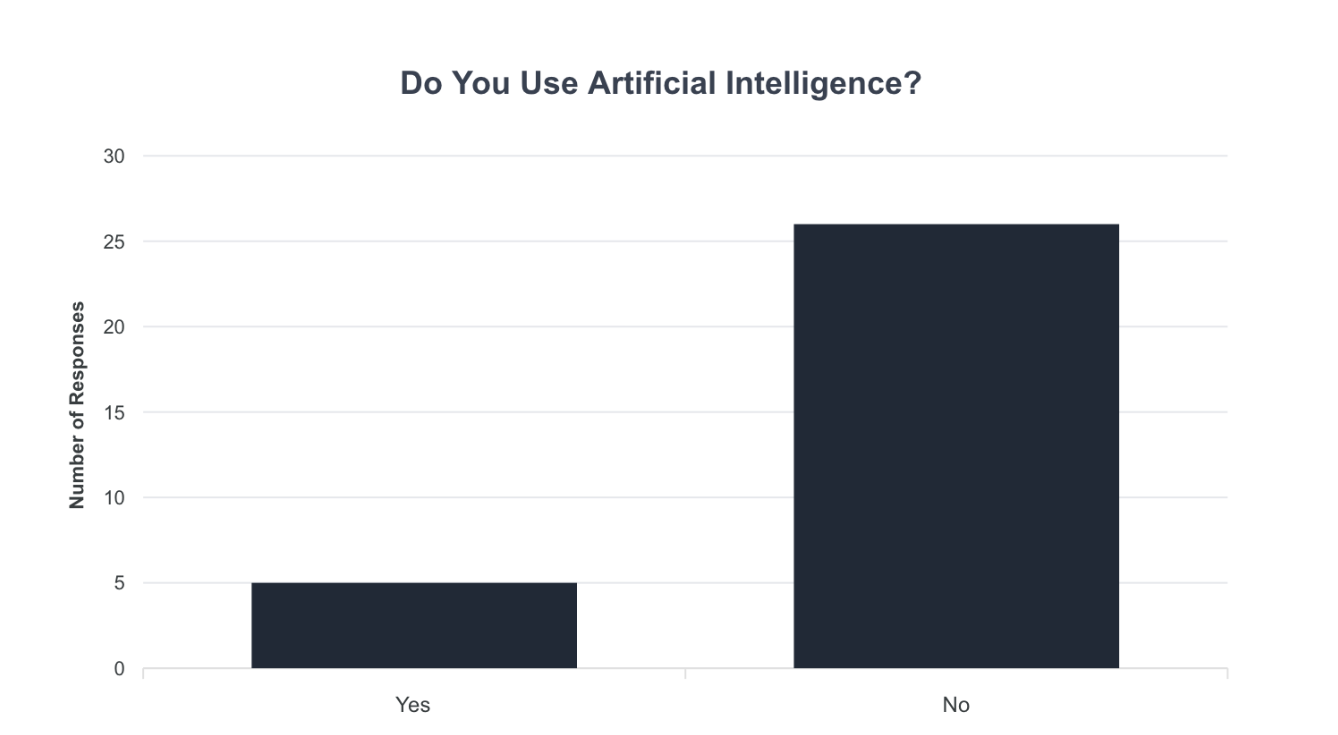
The poll above showcases the answers of 31 students at SLC pulled from an anonymous survey. As you can see, the number of students who answered “no” is greater than the number of students who answered “yes.” Suggesting that the majority of the population of SLC does not use A.I. However, the students who did answer “yes” declined the opportunity to speak further about their use of A.I. in terms of what they use it for and how often.
Upon surveying students on whether or not they use A.I., I pulled aside a student to interview them regarding their thoughts. Gwyn Hartigan ‘28 was one of the students who voted “no” to using A.I. “It’s bad for your brain,” explained Hartigan, “And your critical thinking skills.”
Hartigan drew from a few experiences that they had seen of A.I. misrepresenting items in pop culture, social media, Google A.I. overview, and more. “Who is held accountable when things go sideways?” questioned Hartigan.
However, there’s a different perspective on the use of A.I. by Sarah Lawrence professor James Marshall, who teaches a First Year Studies course titled “Artificial Intelligence and Society: Promise and Peril.” In this class, Marshall has a few main goals. These goals include teaching his students about the evolving A.I. scene and the awareness that one needs when working with A.I.
“We discuss some of the negative aspects such as deepfakes, privacy, elections…” said Marshall. “It’s surprising to me how many people already had a negative attitude towards A.I.”
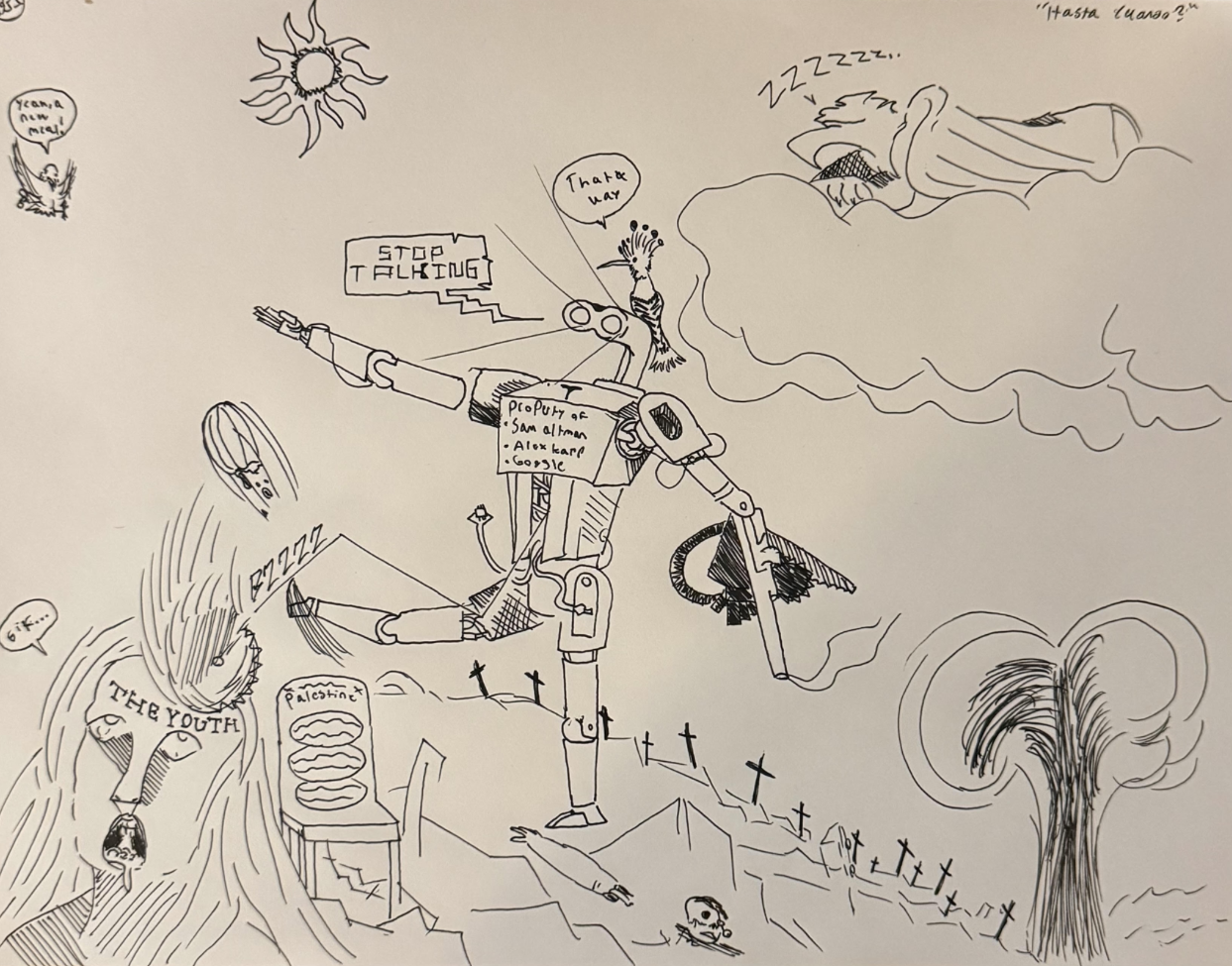
Cartoon by Benin Polanci-Morales
In the first four weeks of class, Marshall has had his students present on movies and science fiction that involve A.I. Students did presentations on works such as Blade Runner, 2001: A Space Odyssey, and even Wall-E, to represent some popular forms of media that have advanced technology and A.I. on display. This way, he can see a glimpse into his students' impressions of A.I. that they already have coming into the class.
While Marshall believes that A.I. can be used for the benefit of society, he also had much to say about the regulation of artificial intelligence as well, pushing for more control over this technology. “In just the past few weeks and months, there’s been public pushback,” explained Marshall. “And A.I. data centers make ordinary people look up and realize that regulation should be in effect.”
In recent days, former Anthropic researcher Jacob Coxen took over the room at a city council chamber and stated that it’s highly likely an “A.I. triggered catastrophe” is a real possibility. Coxen proceeded by saying, “On the current path, I think it’s more likely than not that humanity loses control to these A.I. s and it could end in human extinction.” This has sparked conversation around emergency plans in the case of a real A.I. provoked catastrophe. The New York City Council has proposed options such as a “kill switch”, which would ensure some form of human oversight over every A.I. company, and “whistleblower rewards,” which would give money to those who come forward to report any kind of A.I. wrongdoing in the first 24 hours of becoming aware of the wrongdoing at hand.
In terms of our current administration, President Trump called for self-regulation in a summit that took place at the White House on September 29th. When head-to-head with major A.I. tech executives, Trump said, “There’s a belief that there should be tremendous self-regulation, and we automatically have regulation with the Department of Justice, the FBI, all of that.” Although many people on both sides of this A.I. debate agree that regulation is a must, it’s clear that it’s only a matter of time before this regulation is instituted before it’s too late.
With all things considered, A.I. has made its way to the forefront of media. The future of this technology is completely unknown. Whether there will be regulatory laws instituted or a complete takeover by A.I., it seems like one thing is evident: there still stands a clear divide in the debate on A.I.