Fizz: Does Anonymity Lead to Chaos or Authenticity?
Adrienne Webb ‘30
Source: Fizz
For all those who completed orientation, the familiar feeling of walking to the Barbara Walters Campus Center and watching the screens flip through information is still a fresh memory. For me, however, one slide I think of often was the ‘apps to download’ slide, and what app they left undisclosed. It seemed that everyone but me at the time knew of an app called Fizz, and while I would only download it days later, it was seeping through the freshman class.
For those who have somehow dodged all talk of this infamous app, Fizz is described by the App Store as “ your go-to place to connect with the people who matter to you most”; touching. While I would describe it more akin to your school's only Twitter page, I’m more interested if Fizz truly offers an outlet for “your authentic community” to shine, or if it was a waste of my depleting storage. Moreover, what does the student body think about Fizz’s anonymity; is it good, bad– perhaps neither.
One student, Colin McIntyre ‘30, is someone who abstains from social media as a whole, but hears about Fizz from his friends. He noted that Fizz can be funny and, “ [because of] the anonymous aspect, everyone can be a part of this community”. In fact, he believes such community building is possible in lieu of anonymity, giving “everyone an equal voice”.
Beyond the jokes, McIntyre admits “ the negative is that people can say whatever they want ... it's easy when you think no one is stopping you” or that “you can objectify people” in response to the Fizz crush polls. All of which I would agree with, as I have certainly seen many students roam campus using Fizz as a gateway to ask about public opinions or information to ludicrous functions I cannot mention officially. But Colin isn’t the only student who refutes Fizz’s overwhelming good deeds with a hesitancy for its potentially negative outcomes.
Amelia Neer ‘28 also doesn’t directly post on Fizz, but mentioned that “Fizz tends to be more neutral to negative” because of the lack of consequences to what someone says. It’s important to note that Neer was here the year Fizz was introduced to campus, so it hasn’t had an initial importance to her social scene as some freshmen might claim.
Beyond whether or not Fizz’s anonymity is what gives it its charm, another point of contention I noticed was whether Fizz would still be used if it wasn't anonymous. While Neer does laugh at her friends' posts or campus jokes, she finds that she “would care more about what people have to say if Fizz wasn’t anonymous.” On the other hand, McIntyre believes that “ it would revert to Instagram and be less interesting,” a point he unintentionally shares with another first year.
Unlike the first two students, Ani Nagle ‘30 does in fact use Fizz and currently sits at #574 through posting fun quips. She finds Fizz to be “ multifaceted…useful, fun, and engrossing but also hell on earth” – me too. As another “neutral to negative” stance, she finds that “Fizz wouldn’t be Fizz if it weren't anonymous… [yet] anonymity definitely causes many issues.” Despite all three students agreeing on this issue of anonymity, however, all have revealed that such deviance on Fizz doesn’t necessarily permeate their day-to-day conversation; “ it hasn’t had a major impact on the way I interact…[but] that is not the case for the victims of Fizz fame and infamy though.”
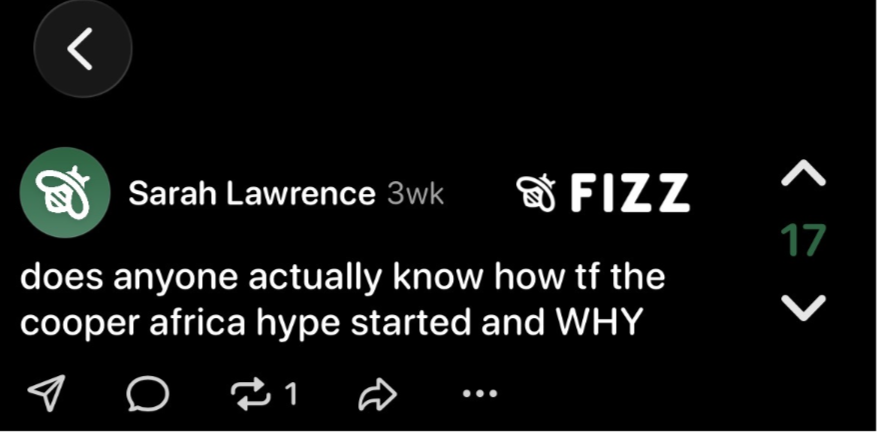
Now, I know what you must be thinking: ‘gosh, 574 words, and I’m still not sure who is actually affected by Fizz in real life.’ To this, I say have more faith in the Fizz “victims”, for the infamous Cooper Africa ‘30 has indeed offered us his words of wisdom on such a subject. Unlike his peers, Africa had quite the unconventional welcome to Fizz after he accidentally called the 2030 Instagram group chat, organised for freshmen and was later slandered on Fizz.
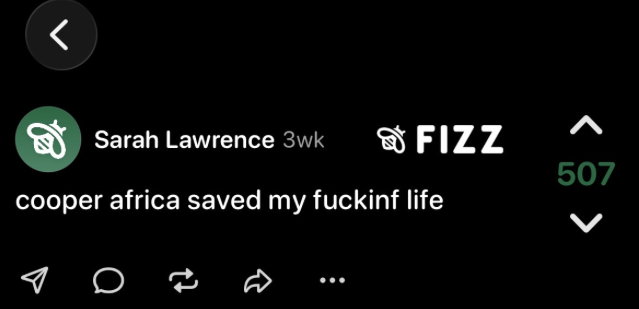
Africa notes his first mention was people claiming he saved their lives, and his fame indeed helped him gain connections with students around campus; “ A ton of people will just walk up to me, and sometimes I have no idea who [they are].” He also claims he never had a problem with anonymity and finds it a neutral entity on campus, as it is “moderated well enough”.
Thus, from two neutral to negative, one neutral to positive, and one neutral only, I would argue that the main takeaway is that Fizz is as good as the people make it. The jokes, slander, and chaos that arise from Fizz are all treats students can look forward to throughout the day. However, as mentioned by every interviewee, sometimes students get too comfortable. I believe that if people remembered that their voice, even anonymous, still holds weight, they wouldn't be as inclined to say bigoted or negative things on Fizz. Whether you're on the top of the leaderboard or simply a reader, every post and vote on Fizz reflects a part of campus; anonymous or not, it's everyone's job to make that fact a positive one.