Pump that Gryphon Spirit Up! An Inside Look Into Sarah Lawrence’s Cheerleading Squad
Annika Beenhakker ‘26
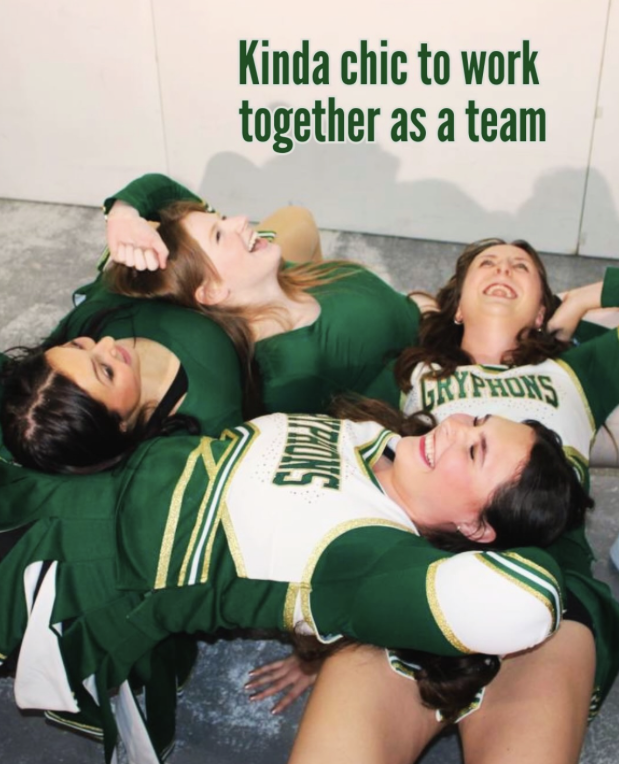
Teammates Guiliana Salemi ‘27, Sarah Jones ‘27, Leah Arban ‘27 and their Captain Marissa Smith ‘27 laugh as they lay on each other’s stomachs. Image courtesy of @slcgryphonscheer on Instagram.
The Captain wore jeans, a bright red lip, and pointed-toe high heels to the 2026 Sarah Lawrence Cheer Squad tryouts. Everyone else wore sneakers. “I feel like I have a lot of power,” Marissa Smith ‘27 whispered as she crouched cross-legged on the uncomfortable wooden floor of Wendy’s Studio. In a room full of squeaky sneakers, Smith most definitely had the upper hand. The fierce click-clack of her heels echoed throughout the dance studio as she observed like a hawk over the twenty individuals going out for the cheer team. Only sixteen will end up on the court this Fall under Smith’s judgment.
The Sarah Lawrence Cheer Squad has been around for three years. For a school so divided between athletes and non-athletes, and for a school so proudly and historically feminist, the advent of a cheer team on this campus was a peculiar one. Immediate opinions were polarized: some were shocked and dismayed at the blasphemy of mostly girls cheerleading for boys, submitting themselves to the increasing “male gaze” on campus; others were enthusiastic at the opportunity to conjoin opposing sectors of the school. Since their inception, the cheerleaders have proven themselves to be highly successful on campus, improving audience numbers significantly and brightening school spirit: “More fans are coming,” Andrew Kim ‘27, a senior on the men’s basketball team, explains, “There would be fans that would come to see us, and fans that come to see them, too. With both of them combined, it’s more people and it’s a lot more fun.”
Tryouts started with stretching. Twenty cowering students followed two choreographers in an elaborate routine of elongated limbs and intricate grapevines. “We’re not looking for perfection, we’re looking for smiles,” Smith yelled out into a sea of nervous frowns. Though they advertise themselves as a club Welcome to All, tryouts result in eliminations. Exclusivity breeds discontent, but Smith explains that the decision boils down to a simple list of qualities in which “Enthusiasm” and “Interacts well w/ others” are the highest scoring. Smith has been cheerleading since she was seven years old. After realizing the toxicity of the business, she took a brief hiatus in high school, but was quick to start again when the opportunity presented itself in February of her freshman year. “I don’t know if you’ve ever seen Bring It On,” Smith laughs, “but obviously we don’t want to be like that.” For Smith, it’s all about bridging the gap between athletics and the rest of the student body, and uplifting everyone on campus in one way or another: “We’re trying to change the stereotypical cheerleader view.” No stealing, no lying, no cheating—only support. The Captain is a modern-day Torrence Shipman.
When the cheer team was initially indoctrinated into the OSIL (Office of Student Involvement and Life) repertoire, the anonymous posting app Fizz erupted into judgmental flames. Students questioned the legitimacy of their athletic merit and questioned why the school even needs cheerleaders to begin with. “There’s always going to be someone who yucks your yum,” co-choreographer Leah Arban ‘27 responds. “There’s a finance club on this campus. You could call that random, too.” Kim recalls a time when the two groups ventured to have a collaborative practice that challenged the basketball team to learn the squad’s halftime routine. “It was so hard,” Kim admits, “We tried to learn one of their dances, and it was impossible.”
Sarah Lawrence College has had a cheer team before, sometime in the early 2000s. This time, though, Smith and her squad are aiming to reverse un-feminist assumptions of a cliched cheer squad, and that begins by expanding far beyond men. When the Captain made the decision to cheer for both the men’s and women’s basketball teams: “It was honestly just like, Duh, why would we only cheer for the men’s team?” It’s a two-way street, though, to maintain Sadie Lou’s feminist reputation. “There’s more people at the men’s games than at the women’s,” Arban notes, “Wouldn’t you want to be at the women’s games if you’re going to call us ‘un-feminist’ for cheering at both?” Sarah Theriault ‘29, who is a sophomore on the women’s team, says that, “It’s always great to have people there for you who want to see you do well.” Theriault cannot recall any games last year in which the opposing women’s team also had a cheerleading squad supporting them from the sidelines.
Tryouts ended with a “splotch,” not a circle, around the Captain. Smith hates circles. They are too worship-y when they surround just one person. They are a team, not a monarchy. The Captain plans to attend law school next Fall. One can imagine the same click-clack of her pointed-toe high heels in the courtroom as she tackles a case with the same uplifting diplomacy and ferocity of programming she has tackled the cheer team with. “I’m just having fun with my fellow teammates,” Smith claims, “It’s more about hyping the crowd than, Oh, look at me, I look pretty and I’m doing this dance. It’s all about how you base your team and your values. And I would say we have a team of people who support women.”