Boy, Take Off That Union Jack and Reject Imperialism
India Patton ‘30
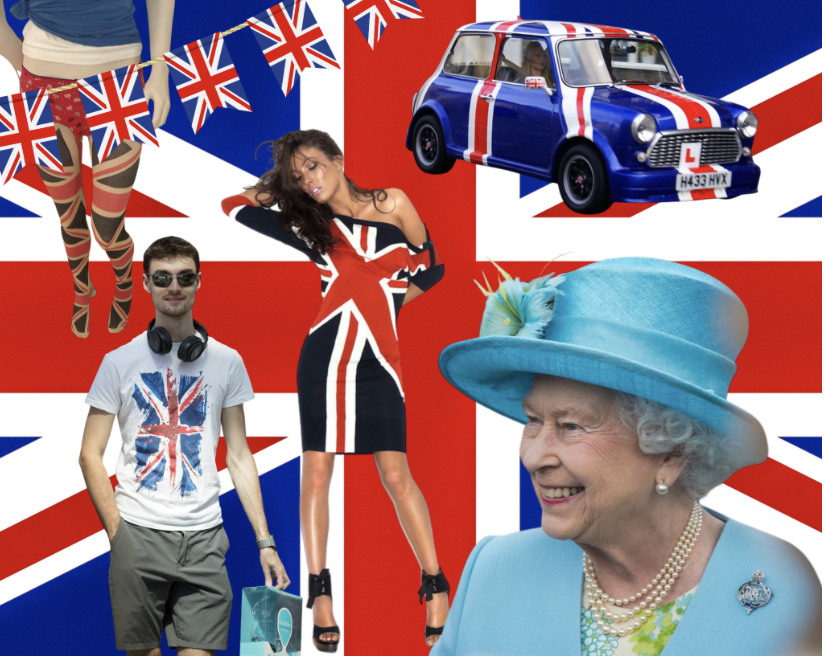
Photo by India Patton ‘30
It's been put on bags, jackets, hats, t-shirts, and a plethora of items sold at Brandy Melville in the past year: the Union Jack. The flashy, bold national flag of the U.K. was first created in 1606 by King James VI and I. The flag merges the Cross of St. George of England, the Cross of St. Andrew of Scotland, and the Cross of St. Patrick of Ireland. It was created to represent the political union of all nations in the British Isles under one rule: The British Crown.
This semester at Sarah Lawrence College (SLC) has been no different. Walking around campus, I’ve seen it on almost every type of accessory and garment imaginable. Still, this is not a new phenomenon in the world of personal style.
The Union Jack first became a fashion trend in the 1960s when bands such as The Who and The Rolling Stones adopted it into their bands’ aesthetics. In the ‘70s, the counterculture punk movement, led by people such as Vivienne Westwood, defaced the flag as a symbol of anti-establishment and political satire. The flag reached its peak global popularity in the ‘90s with the explosion of Britpop and the “Cool Britannia” cultural movement, headed by the band Oasis and Spice Girls member Geri Halliwell — also known as Ginger Spice.
The flag to this day has been used by countless British fashion houses, singers and stars — including Kate Moss, Alexander McQueen and Dua Lipa — to show off British patriotism and culture.
In the past few years, the Union Jack has exploded in TikTok algorithms and Pinterest boards as a nod to Y2K fashion. SLC first-year Aspen Lytle Pridmore, who grew up in London, said she has noticed a strong resurgence.
“While I was living in Colorado near the end of high school was really when I started noticing it,” Lytle Pridmore said. “Not even in person, because I did not go to a school where people vibed like that. Since being here, I think I've seen it a few times on the sweaters, on tank tops with the whole design of the Union Jack. I'm sure if I visited London this year or last year, at any point, I would have seen it.”
So, why is this flag back now? Elizabeth Ross ‘30 said the aesthetic merit of the flag is extremely enticing.
“There's a resurgence of the late 2000s-2010s style coming back,” Ross said. “I think that a big part of that was the Union Jack, because specifically London was very leading in fashion and cultural influence at that time. Because it's becoming more popular in the U.S. right now, most people don't think about the Union Jack as a flag. They only associate it with the style, the aesthetic.”
Ross’ father is from Balfron, Scotland, and her maternal side is a fourth-generation Irish-American family. To those not of English descent, this flag can carry a different, darker meaning.
“At a very basic level, it's the flag of the United Kingdom,” Ross said. “But, to me, it's not really a good image to represent the U.K. right now, especially as we're seeing various independence movements in countries in the U.K., namely Northern Ireland, Scotland and Wales. It's representing the U.K. as one country, which, in my mind, it's not. A lot of people who live in British countries that are not England do not view the U.K. as one country.”
Ireland was first colonized by England in the 12th century with the Anglo-Norman Invasion. The crown exerted full control of Ireland. Laws established and enforced by the crown made it illegal for the Irish to practice Catholicism, hold commissions in the army, hold professions in law or medicine, vote, own weapons, purchase or inherit land, use the Irish language in courts, and much more.
After Henry VI and I moved the royal court from Edinburgh to London, Scotland lost most of its political independence. Legislation in the 18th and 19th centuries banned traditional Highland clothing like tartan, disarmed Scottish clans, and enforced mass evictions where local populations were displaced for sheep farming.
In the late 11th century, under orders from the English Crown, Wales was invaded and English settlements were established. Wales' legal identity was entirely tied to the crown. In the 19th century, the Welsh language was demoted to the uneducated by the British government. The Welsh Not and other punishments, such as beatings, were used to discourage the learning and inheritance of the language.
What was the result of these various invasions and consolidations of power? The Irish, Scots and Welsh were seen as second-class citizens in their own countries. English politicians and monarchs for centuries enforced legislation to wipe out Celtic culture and force-Anglicize all of the British Isles.
The Union Jack is a representation of this amalgamation of control. Ireland, Scotland and Wales still, to this day, do not have autonomy to govern themselves fully and freely.
However, for many people living in the U.K., the Union Jack is just a way to represent their culture and where they are from.
“It's not even necessarily like trying to align myself with the politics that are going on there, [it's] more so away from me to represent where I'm from and a key part of who I am,” Lytle Pridmore said. “I still have the accent. I lived there for a period of time. It was where some of my very early memories are from.”
Ross shares different sentiments when it comes to the Union Jack.
“To me, has a lot of connotations of very traditional, strict ways of governing the ways of life in the U.K.,” Ross said. “That's not something that you should be promoting in your everyday lifestyle, especially living in the U.S. In places like Edinburgh, Scotland, you wouldn't see the Scottish flag. In Ireland, you wouldn't see the Tricolor. You would see the Union Jack. And, when the U.K. had colonies in other countries, such as in India, the Union Jack was what was placed there. I think that it can symbolize many other things to people. But first and foremost, in my mind, it is a sign of imperialism.”
Not only does the Union Jack represent imperialism and colonization to many, but the upward trend of the Union Jack in Gen-Z fashion also correlates with the growth of the Reform Movement in the U.K..
“In England, there's a huge Reform Movement starting,” Ross said. “The Union Jack has been used very heavily in that.”
The British Reform Movement, officially known as Reform UK, is a right-wing, populist and nationalist political party headed by Nigel Farage. It was initially launched during Brexit in 2019 to campaign for the U.K.’s exit from the European Union.
The party's policies include a complete freeze of non-essential immigration, mandatory English fluency for immigrants, restriction of welfare access, a repeal of the 2008 Climate Change Act, and recruitment of an additional 40,000 police officers across the U.K.
In recent years, this movement has achieved massive gains, most notably in the 2025 local elections. While the party’s ranking in the polls has shrunk in the last year, the national symbol this party has used to garner public support is the Union Jack.
Lytle Pridmore said in the U.K. there is a youth movement to reclaim the Union Jack as a way to reject the reformist use of the symbol.
“There's so much happening in the world of politics right now,” Lytle Pridmore said. “People are finding ways to reclaim certain things where we don't want this to be a representation of all of this bad stuff, we want to be a representation of these good things. So, claiming it for better reasons. Not wanting it to represent the far right of England, but wanting it to represent more of those values of this being for us, this is for the people who live in the U.K. This isn't for the people who want to destroy the country.”
Even if part of this reclamation is used for anti-reactionary purposes, a majority of the people of Scotland, Wales and the North of Ireland do not identify as British. The legacy of English rule has left deep scars and burns in the hearts and bodies of the Celtic people, something that cannot be forgotten easily. With the recent meeting of the leaders of these three nations coming together to sign a joint declaration of self-determination in Sept., this issue is more prominent than ever.
People not from the U.K. or who are unfamiliar with British politics may have no idea of the legacy and prevailing attitude the Union Jack holds internationally and domestically. Many people in the U.S., including students at SLC, may be wholly unaware of what Reform UK is, the extent of British colonial occupation in places such as Palestine, and the legacy of British ethnic and cultural cleansing worldwide.
“People who wear it, they aren't wearing malicious intent,” Ross said. “But I think that with anything that isn't part of your heritage or something that you haven't experienced firsthand, it's something that you should think a little bit deeper about. If you're going to wear it, I think that you should just be aware of where it comes from, what it represents to so many people. There's a reason why people are shying away from it in the UK right now. That's because of the Reform Movement. So even if you are aware of the historical imperialism the historical implications of the Union Jack, I think that everyone should be a little bit more globally conscious about political situations in other countries.”
Flags carry weight; they carry meanings that extend far beyond the aesthetic merits of a piece of cloth. In order to truly have solidarity with oppressed people and cultures, people must think critically about what symbols are being promoted and advertised. The Union Jack is an imperial symbol; wearing it is condoning the actions of the imperial government. If you choose to wear the flag, be aware of the colonial connotations you are carrying with you.
“I think that, unfortunately, it's c---- as f---,” Ross said. “It looks great. It does. But you do just need to have a little bit of awareness if you're going to wear it.”