Our Colleges Are Failing Women (And They Always Have Been)
Katie Oravecz ‘29
Trigger Warning: This article contains discussions of Sexual Assault
Source: @arghavansallesmd on Instagram
When I read the first of many headlines that followed the filing of the lawsuit against Cornell University and seven students for the alleged gang rape of Jane Doe in 2024, I was feeling a variety of things. I felt disgusted and outraged that one human being could do that to another and that 57 men saw that message in that group chat and chose to do nothing. I felt pride in the way women came together to advocate for survivors and anger toward those who attempted to turn this into a left-right political issue. However, there was one thing I was not feeling: surprise. The complicity of Cornell administrators, the lack of consequences for these male students and the university's inaction — none of this was surprising to me. In fact, when it comes to sexual assault cases on college campuses, this narrative has become very familiar.
What happened at Cornell was in no way isolated. According to a fact sheet from the American Psychological Association, campus sexual assault makes up the biggest proportion of on-campus crimes in the U.S., with around eight violent sex offenses occurring per 10,000 students. Schools often underreport these crimes, with institutions facing fines in the past for skewing their rape statistics, as was the case with Liberty University in 2024. I, like many other people, have witnessed or heard of several sexual assault cases being ignored or mishandled at every educational level throughout my life.
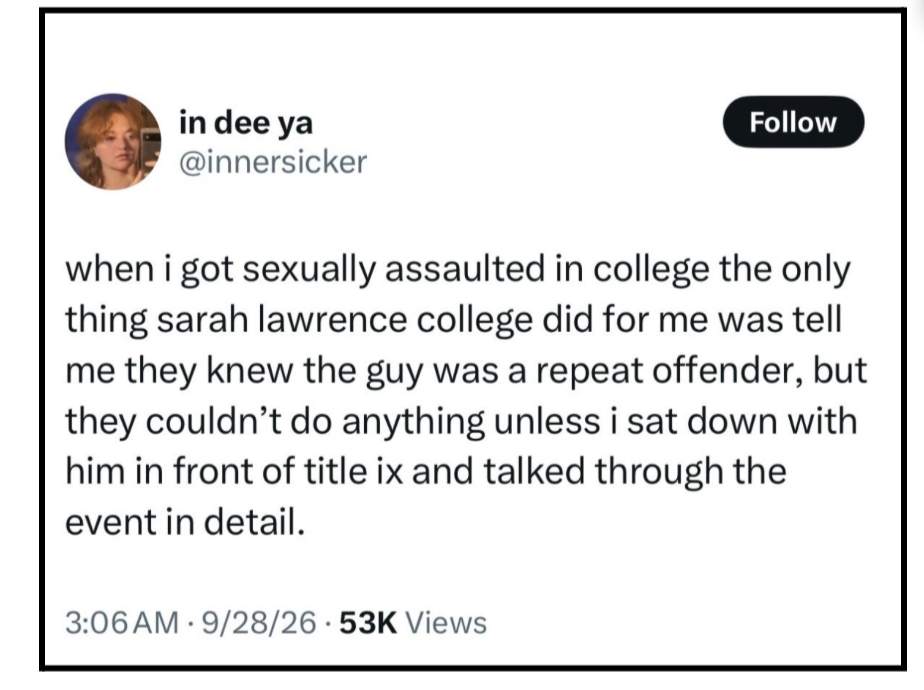
Rape, and its ignorance, is not an isolated culture; it is not limited to conservative institutions such as Liberty, or well-endowed ones like Cornell. It would be too easy to point out that the type of student culture that exists at Cornell, or other “normal” universities, is not one we have here at Sarah Lawrence College. That we’re just not “that kind of school.” Indeed, Sarah Lawrence possesses a small student body, has a majority of women, and no Greek life. This does not mean it is absolved of Title IX-related issues — nor their culture; think of the frat-themed party thrown just a couple of weeks ago — quite the opposite, in fact: Sarah Lawrence has a higher rate of sexual assault than Cornell does.
Looking at statistics from Campus Safety, Sarah Lawrence recorded 24 cases of forcible sex based offences in the past three years. In addition, the college saw 27 instances of stalking and dating violence, both of which are covered under federal Title IX regulations. That is, in total, 51 cases of Title IX violations between 2023 and 2025.
According to a CBS News report, Cornell, on average, reports eight incidents per 5,000 students per year (about 238 total per year), significantly higher than the national average of four incidents per 5,000 students. Sarah Lawrence has, for three years, consistently reported seven cases of rape per year with a total student population of under 2,000. And those are just the cases we know about. As stated in a 2010 article from the American Civil Liberties Union, 95% of campus rapes go unreported. Looking at the Cornell case, it’s not surprising why women might feel discouraged from disclosing information to their institutions when it comes to instances of sexual assault.
It should be our basic assumption that we as a society are doing everything in our power to combat sexual violence. But unfortunately, that is not the case when it comes to higher education. It increasingly seems that when it comes to rape in colleges, the ill-treatment of these cases is not an outlier. It’s the norm.
Sarah Lawrence updated their Title IX proceedings over the summer to a much more comprehensive framework that includes a second set of criteria for sex-based misconduct, modelled after NY state law and offers updated protections to students who report sexual assault.
The updated framework is a good thing, but it does not solve the problem. Cornell’s sexual assault policy operates within the same Title IX framework that Sarah Lawrence’s does, under the same New York state regulations. Many of the decisions made in these processes fall to the discretion of administrators involved, which is partly why the misconduct at Cornell was allowed to happen. Students at Sarah Lawrence deserve assurance that what happened at Cornell will not happen here.
As of Oct. 19, Sarah Lawrence or its Title IX office has yet to release a public statement about the Cornell case. This decision may seem beneficial from a publicity standpoint, but when it comes to systemic issues, business as usual is unacceptable. This is not a distant problem, and the college cannot treat it as such. Matters of rape are not matters of politics or publicity. They are matters of safety, dignity and basic human rights. The institution and its administration must take a vocal and definitive stance against rape and sexual violence. That means unequivocally condemning this type of behavior and working to dismantle the environments that promote it, making clear that the institution stands with survivors of sexual assault and ensuring that the cases that are reported are prioritized and treated with the highest level of care and attention from every administrative body of the college. For starters, they can stop pretending the Cornell case never happened.
According to a 2020 study, one in four women will experience sexual assault in their lifetime. Of those, less than five percent are reported, and police dismiss one in five as baseless. Women across the world live with the reality that there is a high chance they will be assaulted at some point in their lives, and if/when they are, they will most likely not be taken seriously.
Combating rape cannot stop with bystander training or consent education or Campus Safety walking around wearing purple hats. Cornell had these frameworks, as do most colleges in this country. Combating rape means addressing systemic institutional structures that serve the interests of the accused over the victims. Educational institutions should be leading this charge. These men learn at these crucial stages of their lives that when they commit acts of violence against women, they will face no real consequences. And when they graduate and enter the real world, be it boardrooms, hospitals (two of the seven men accused were pre-med), or even the halls of Congress and the White House, they do so with the knowledge that whatever they do to women, they will get away with.
The Cornell case is not an outlier. It’s the standard. It’s the natural culmination of the power structures of a system inside higher education that has been failing women from the start. And when one operates within these power structures, silence is not neutrality; it’s complicity.